> ## Documentation Index
> Fetch the complete documentation index at: https://docs.voicemetrics.ai/llms.txt
> Use this file to discover all available pages before exploring further.
# Custom Actions
> Custom Action enables your voice agent to fetch or send data to any external application via real-time API calls. It's ideal for integrating third-party CRMs, marketing tools, databases, or automation platforms directly within the conversation flow.
## **How It Works**
* **Fetch Data from External Tools**
* Pull info during a live call to personalize conversations or validate data.
**Use Case Example:**
* Check if the caller is an existing contact in your CRM
* Retrieve subscription status from your billing system
**Prompt Example:**
* Use condition **#Check\_Lead\_Status** to retrieve caller details using the phone number.
### **Send Data to External Tools**
Push collected call data to external apps for follow-up actions.
**Use Case Example:**
* Send lead details to a CRM or spreadsheet after the call
* Trigger a drip email campaign in your marketing platform
**Prompt Example:**
* Use tool #Send\_Lead\_Info to push the caller's name, email, and interest to CRM.
## **Connect with 1000+ Apps using Automation Tools**
Easily integrate with platforms like:
* **Zapier**
* **Make (Integromat)**
* **n8n**
You can connect to 1000+ apps like Google Sheets, HubSpot, Pipedrive, Salesforce, Mailchimp, Notion, Airtable, ClickUp, and more.
**Use Cases with Automation Tools:**
* Add a contact to **Google Sheets** after the call
* Create a task in **ClickUp** for a sales rep
* Start a **WhatsApp** or **email sequence** via **MailerLite** or **ActiveCampaign**
* Add or update contacts in **HubSpot CRM**
* Record interest scores in the **Notion database.**
## **Prompt Example Using Custom Action**
* Use tool #Fetch\_Existing\_Customer to check the caller status in our CRM.
* If not found, use tool #Send\_New\_Lead to send their name, phone number, and intent.
## **Setup Instructions**
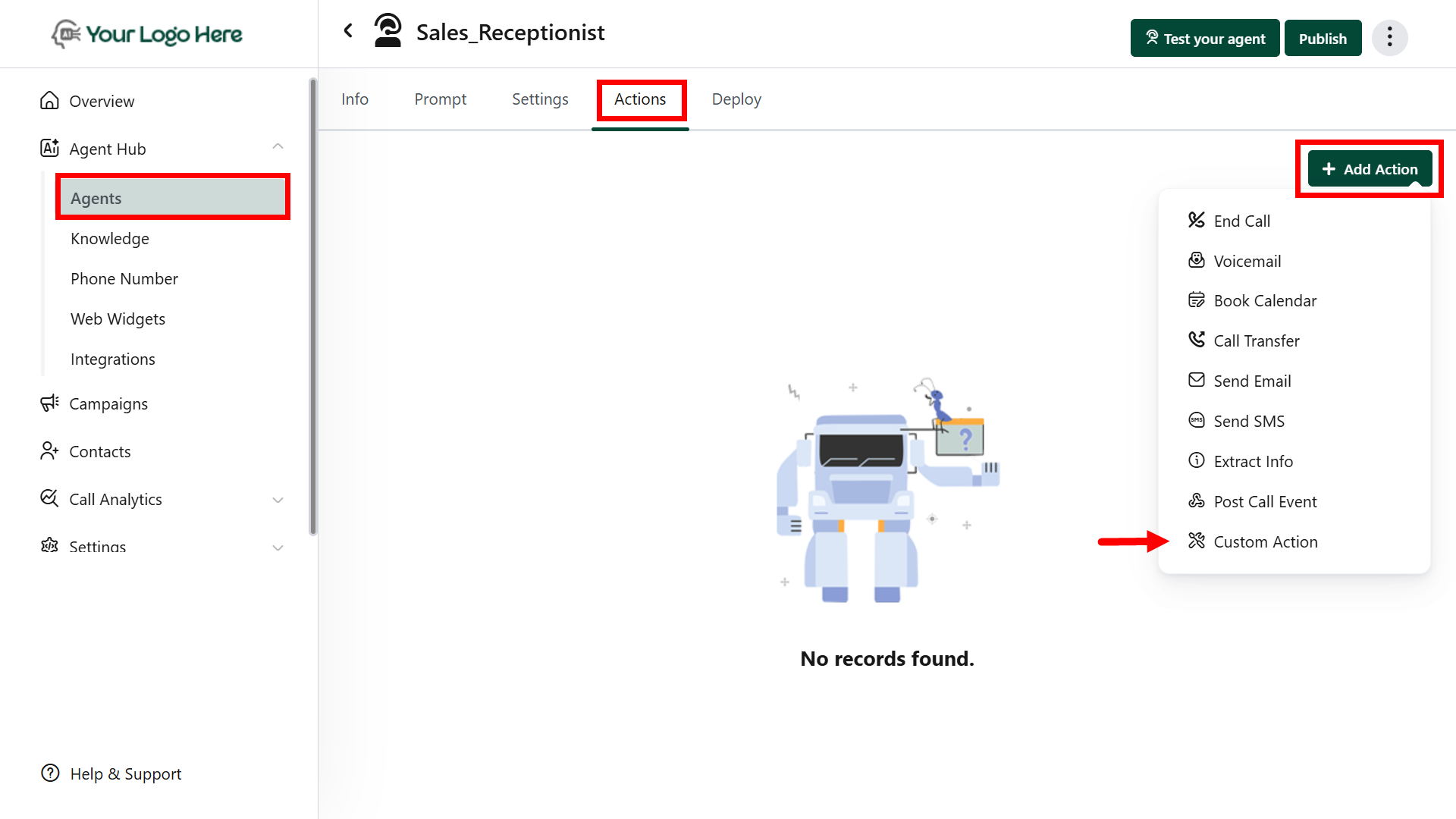
**Go to** the **Agents and Edit** → Navigate to **Actions** → Select **Custom Actions**.
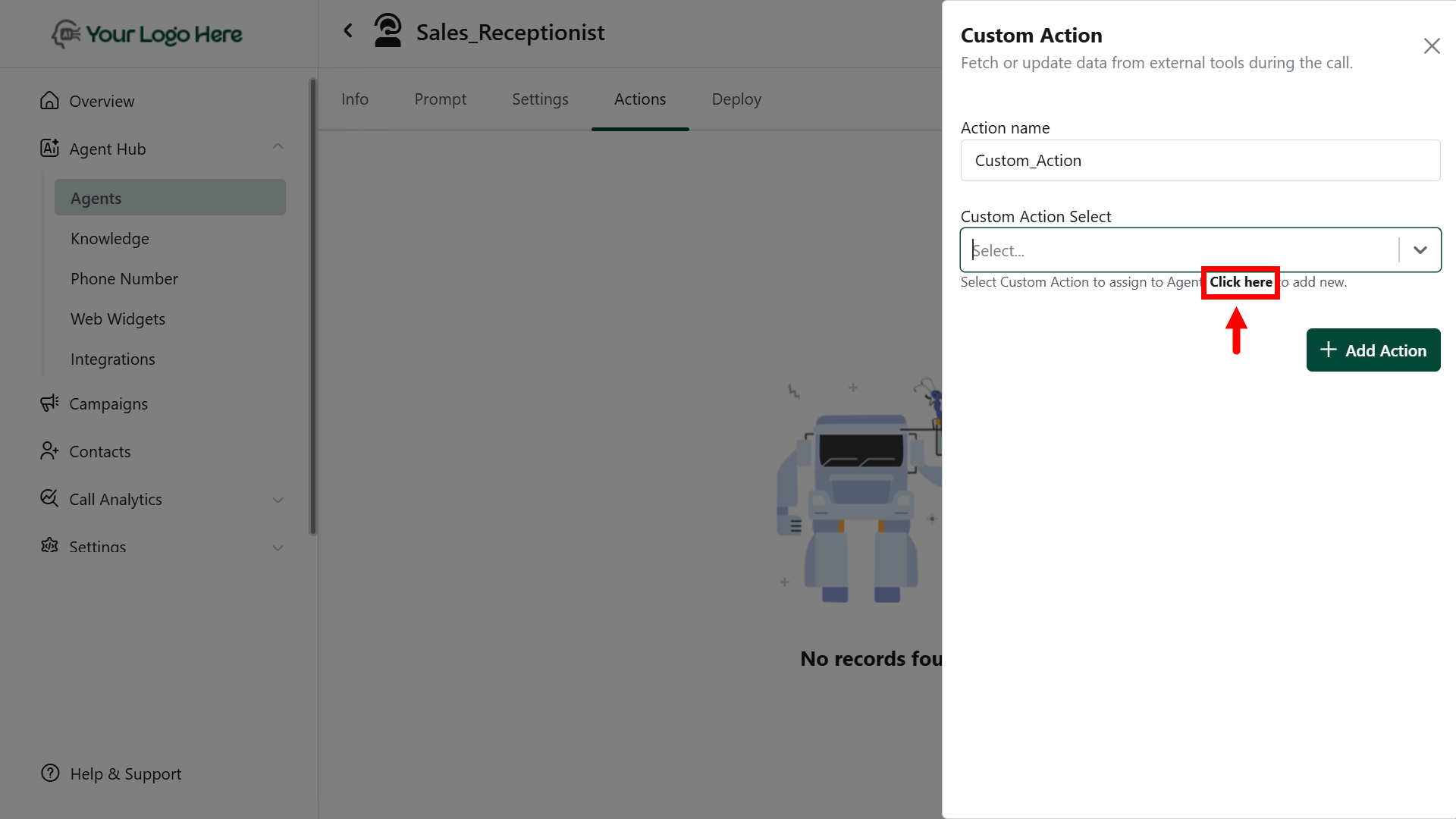
 * **Click** on “Click here" to add a new Custom Action.
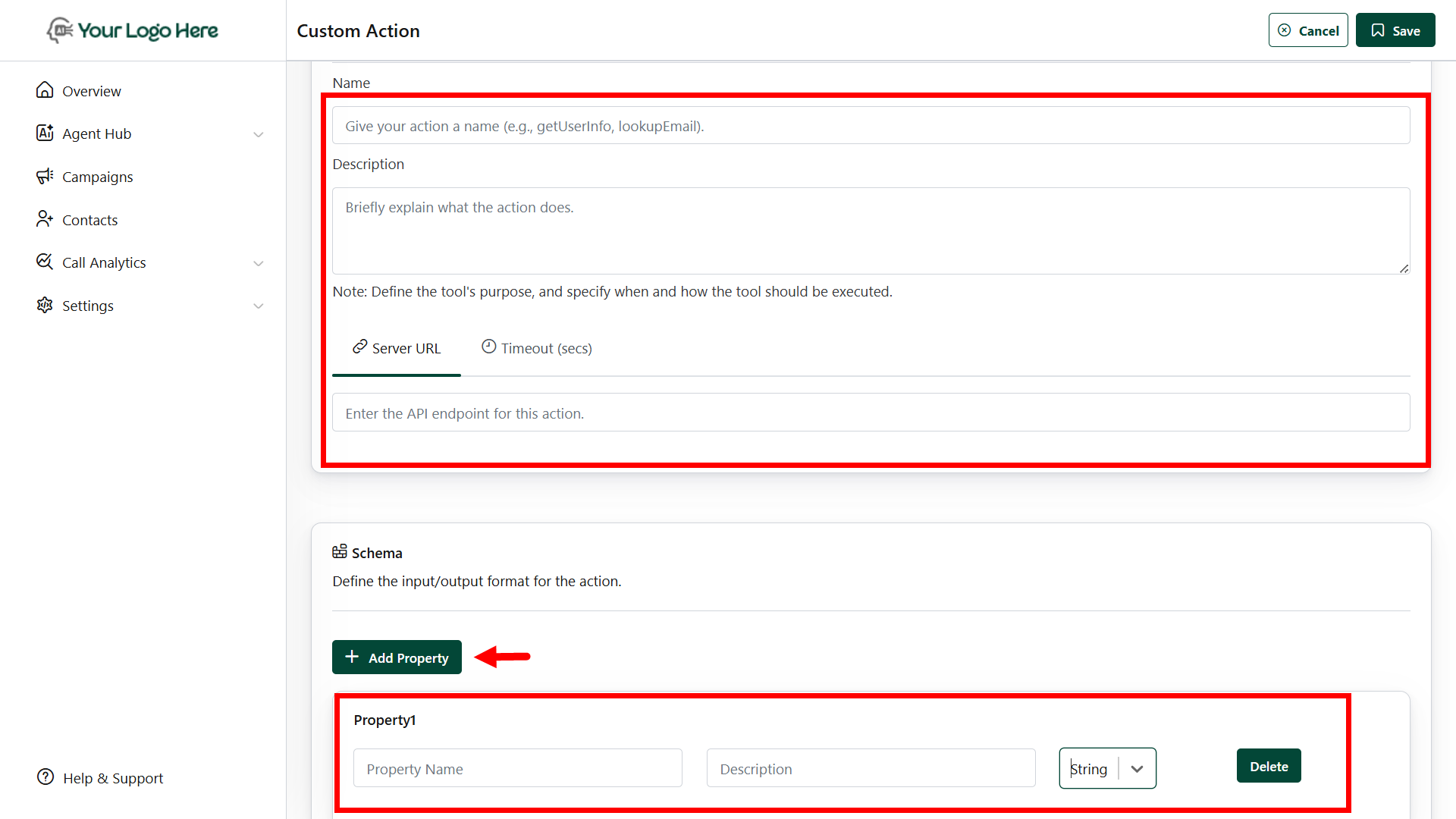
 * **Fill in the required fields:**
* **Name**\
Provide a unique name for your action (e.g., getUserInfo, lookupEmail). This will be used in the prompt as #ActionName.
* **Description**\
Add a short description to guide the AI on when and how to use this action.
* **Server URL**\
Enter the target API endpoint that this action will call.
* **Schema**\
Define the input/output parameters of the API:
* **Property Name** – Define the field name (e.g., email, userId)
* **Description** – Explain the purpose of the field
* **Type** – Select the data type: String, Number, Boolean, Object, or Array
* **Save** the action.
* **Fill in the required fields:**
* **Name**\
Provide a unique name for your action (e.g., getUserInfo, lookupEmail). This will be used in the prompt as #ActionName.
* **Description**\
Add a short description to guide the AI on when and how to use this action.
* **Server URL**\
Enter the target API endpoint that this action will call.
* **Schema**\
Define the input/output parameters of the API:
* **Property Name** – Define the field name (e.g., email, userId)
* **Description** – Explain the purpose of the field
* **Type** – Select the data type: String, Number, Boolean, Object, or Array
* **Save** the action.
 * In the **Agent Settings**, go to **Actions → Custom Actions** and select the actions your agent should use during the call.
* **Link it in your agent prompt** using the format **#ActionName**.
## **Best Practices**
* Use descriptive and meaningful action names
* Validate endpoints with Postman before linking
* Use automation tools (Zapier/Make/N8N) if the destination app doesn't support APIs
* Combine with #Extract\_Info to send structured data
* Ensure APIs respond within real-time limits (\~2-3 seconds)
* In the **Agent Settings**, go to **Actions → Custom Actions** and select the actions your agent should use during the call.
* **Link it in your agent prompt** using the format **#ActionName**.
## **Best Practices**
* Use descriptive and meaningful action names
* Validate endpoints with Postman before linking
* Use automation tools (Zapier/Make/N8N) if the destination app doesn't support APIs
* Combine with #Extract\_Info to send structured data
* Ensure APIs respond within real-time limits (\~2-3 seconds)